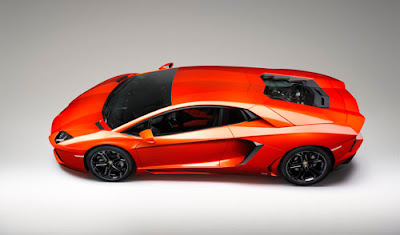
The Lamborghini Veneno features a twelve-cylinder power unit with a
displacement of 6.5 liters, an extremely fast-shifting 7-speed ISR
transmission with 5 driving modes and permanent all-wheel drive, as well
as a racing chassis with pushrod suspension and horizontal
spring/damper units. Above all, however, the Veneno benefits from the
very special expertise that Automobili Lamborghini possesses in the
development and execution of carbon-fiber materials - the complete
chassis is produced as a CFRP monocoque, as is the outer skin of this
extreme sports car.
The inside, too, features innovative,
Lamborghini-patented materials such as Forged Composite and Carbon Skin.
In the year of its 50th anniversary Automobili Lamborghini is
presenting an extremely exclusive model at the 2013 Geneva Motor Show.
Only three unique units of the Lamborghini Veneno will be built and
sold. Its design is consistently focused on optimum aerodynamics and
cornering stability, giving the Veneno the real dynamic experience of a
racing prototype, yet it is fully homologated for the road. With a
maximum output of 552 kW / 750 hp, the Lamborghini Veneno accelerates
from 0-100 km/h in just 2.8 seconds and the top speed for this
street-legal racing car stands at 355 km/h. It is priced at three
million Euros plus tax - and all three units have already been sold to
customers.
Fully in keeping with the tradition of the brand, the
name of the Veneno originates from a legendary fighting bull. Veneno is
the name of one of the strongest and most aggressive fighting bulls
ever. He is also famous for being one of the fastest bulls in the
history of bullfighting. His name became popular in 1914, when he
fatally wounded the famous torero José Sánchez Rodríguez during the
bullfight in the arena Sanlúcar de Barrameda's, Andalusia, Spain.
The Design
The
Lamborghini Veneno brings the aerodynamic efficiency of a racing
prototype to the road. Every detail of its form pursues a clear function
- exceptional dynamics, optimum downforce with minimal drag and perfect
cooling of the high-performance engine. Yet the Veneno is unmistakably a
Lamborghini; it sticks firmly to the consistent design philosophy of
all the super sports cars from Sant'Agata Bolognese. That includes the
extreme proportions, as well as the powerfully arrow-shaped front end
and the interplay between razor-sharp lines and precise surfaces.
The
entire front end of the Lamborghini Veneno has been laid out for
perfect airflow and downforce. The front end works as a large
aerodynamic wing. Large channels guide the air to the outlets in the
front hood and in front of the windshield, as well as to the front
wheels. Characteristic for Lamborghini is the Y shape of the angular
headlamps that reach well into the fenders as well as the scissor doors.
The
division of the fenders from the car body is a reference to the world
of sport prototypes and optimizes at the same time the aerodynamic flow.
The side line of the Veneno is therefore dominated by enormous sills
and the mighty wheel arches front and rear. Here, too, sophisticated
aerodynamics ensure perfect airflow to the large openings for engine
cooling and intake air.
Just like the front end, the rear of the
Lamborghini Veneno has also been optimized for underbody aerodynamics
and high speed cornering stability. The smooth underbody transitions
into a substantial diffuser framing the four sizable exhaust pipes
divided by a splitter to increase the level of downforce peak. Large
openings serve to ventilate the engine bay and manage the airflow to the
rear wing, with the only sealed area at the rear being reserved for the
license plate. The rear lights, including brake lights, indicator
lights and fog lights, pick up the Y theme as well. The engine cover
sports six wedge-shaped openings, with the focus here, too, on optimum
dissipation of heat from the engine. The engine cover extends into a
large central "shark" fin, which improves efficiency during braking and
rear-end stability, by delivering additional downforce at high yaw
angles and thus increasing the high-speed cornering performance.
The
adjustable rear wing's design is the product of Motorsport experience
and extensive aerodynamic simulation to ensure the best performance of
rear wing interaction with rear diffuser air flow.
The exclusive
alloy wheels measure 20 inches at the front and 21 inches at the rear
and are equipped with center mountings. Their design is also determined
by aerodynamic functionality - a carbon-fiber ring around the wheel rim
works like a turbine to deliver additional cooling air to the
carbon-ceramic brake discs.
The Lamborghini Veneno is painted in
an all-new, grey metallic-look color with individual parts gleaming in
the black of the visible carbon-fiber structure. The only car to display
all three colors of the Italian flag as an accent is the car shown at
Geneva, the unit which will remain property of Lamborghini. The three
cars sold to customers each feature a single color of the Italian
national flag, together a triology in green, white and red accents and
thus representing each a unique piece.
The Technology
The
Veneno is further proof of Automobili Lamborghini's unique competence in
CFRP-based lightweight design. A monocoque made from carbon-fiber
reinforced polymer forms the basis of the Veneno. It is largely similar
to the Aventador monocoque - as are the aluminum sub-frames front and
rear - although its form has been adapted to the new design. All
exterior parts are made from CFRP. The Lamborghini Veneno meets all
safety and registration requirements worldwide, and naturally also
incorporates a full complement of safety systems from airbags through to
the adapted ESP handling system.
Carbon fiber dominates the
interior of the Lamborghini Veneno, too. The carbon fiber monocoque
becomes visible inside the car in the area of the central tunnel and the
sills. The two lightweight bucket seats are made from Lamborghini's
patented Forged Composite. The woven carbon-fiber CarbonSkin® is used to
clad the entire cockpit, part of the seats and the headliner. This
unique material is soaked in a very special kind of resin that
stabilizes the fiber structure, while allowing the material to remain
supple. Like a hi-tech fabric, this extremely fine-looking carbon-fiber
matting fits perfectly to any form, and it reduces weight.
The
racing personality has been transferred also to the instrument panel. It
has been completely redesigned and now, thanks to an aggressive
graphics and to the introduction of some additional features like the
G-meter, provides all necessary information to the driver for control of
the car.
The systematic, carbon-fiber, lightweight design of the
Lamborghini Veneno is not only visible, it is also evident on the
scales: With a dry weight of just 1,450 kilograms (3,190 pounds), the
Veneno is even 125 kilos (275 pounds) lighter than the already extremely
lean Aventador. The highly beneficial power-to-weight ratio of 1.93
kg/hp (4,25 lbs/hp) guarantees a performance that is nothing short of
mind-blowing. Even the stunning acceleration figure of 2,8 seconds
cannot adequately describe it. Despite an aerodynamic setup configured
for extreme downforce, the Veneno possesses exceptionally low wind
resistance which allows it to reach a top speed of 355 km/h (221 mph).
The
twelve-cylinder with a displacement of 6.5 liters is a thrilling
combination of absolute high-revving frenzy and phenomenal pulling
power. Its output has been raised to 552 kW / 750 hp, facilitated
through enlarged intake paths, optimized thermodynamics, a slightly
higher rated rpm and an exhaust system with even lower back pressure.
The ISR manual gearbox, permanent all-wheel drive and pushrod suspension
have all been specifically adjusted to meet the demands of the
Lamborghini Veneno.
The Lamborghini Veneno celebrates its first
public appearance at the 2013 Geneva Motor Show. The vehicle on show is
the number 0, the Lamborghini test vehicle. Its future has not been
determined yet, but it will allow Lamborghini to continue its activity
of testing and innovation, both on the road and on the race track. The
trilogy made of three unique vehicles will be produced in the course of
the year 2013 and handed over to their future owners.